Showing posts with label Study PMP. Show all posts

Sunday, May 18, 2014

Project Integration Management - Close Project or Phase

This phase finalizes all activities across all the process groups to formally complete the project or the phase. The project manager is responsible for reviewing all prior information from the previous phase closures to ensure all the work is completed.

Lets look at the Inputs, Tools and Techniques and Outputs of this process:


1) Project management plan

  • This plan defines what constitutes project completion
2) Accepted deliverables
  • May included:
    • Approved product specifications
    • delivery receipts
    • work performance documents 
    • partial or interim deliverables for phased or cancelled projects
3) Organizational process assets
  • Project or phase closure guidelines or requirements
  • Historical information and lesson learned knowledge base
4) Expert judgement
  • They (other PM's, PMO, professional associates) ensure the project or phase closure is performed to the appropriate standards
5) Analytical techniques
  • Regression analysis - series of input variables are examined in relation to their corresponding output results in order to develop a mathematical or statistical relationship
  • Trend analysis - uses mathematical models to forecast future outcomes based on historical results (Budget, cost, schedule or scope) 
6) Meetings
  • Can be face to face, virtual, formal or informal and the types of meetings can be:
    •  lessons learned
    • closeout
    • user groups
    • review meetings
  • You should conduct many meetings to keep everyone informed on what is going on with the project. Documentation of these meetings with meeting minutes will help track discussions and decisions that were made. 
7) Final product, service or result transition 
  • Transition of the final product, service, or result that the project was authorized to produce
8) Organizational process assets updates
  • Project files
  • Project or phase closure documents
  • Historical information and lessons learned 
Source: PMBOK 5th ed. 

Project Integration Management - Perform Integrated Change Control


This process reviews all the change requests or modifications to project documents and approves or rejects the changes. Within this process we also review configuration control which is a collection of formal documented procedures to help document changes the way the organization requires. This helps us manage what changes are made during the project as we can document and track back the reasons why things changed or who requested the change. Managing this helps the project manager control time, cost and scope. Some of these configuration management actives include the following:
  • Configuration Identification
    • where you label configuration items with unique identifiers
    • identify the documentation for each configuration item
    • group related items into baselines
    • labeling changes to configuration items and baselines
  • Configuration status accounting - information recorded and reported which includes information about:
    • listing of approved configuration identification
    • status of proposed changes to the configuration
    • implementation status of approved changes
  • Configuration verification and audit - ensure that the composition of the items are correct and that the changes are registered, assessed, approved, tracked and correctly implemented. 
Lets look at the Inputs, Tools and Techniques and Outputs of this process in more detail. 


1) Project management plan
  • Scope management plan
  • Scope baseline
  • Change management plan
2) Work performance reports
  • resource availability
  • schedule and cost data
  • earned value management (EVM) reports
  • burnup or burndown charts - burnup charts shows how much work has been completed and the  total amount of work and a burndown chart shows how much work is remaining in the project
3) Change requests
  • If any changes are determined to be made while doing this process you would submit a formal change request proposal. The changes could be requested due to the need for the following:
    • Corrective action - realign an activity tot he project management plan
    • Preventive action - make sure that future performance is aligned
    • Defect repair - modify a nonconforming product
    • Updates - changes to project documents, plans etc.
4) Enterprise environmental factors
  • The factors outside of anyone's control that would affect the way you perform integrated change control would be:
    • Scheduling software tool
    • configuration management system
    • information collection and distribution system
    • web interfaces to other online automated systems
5) Organizational process assets
  • The business organization will have many assets that will influence how you perform integrated change control that may include the following:
    • Change control procedures
    • Procedures for approving and issuing change authorizations
    • Process measurement database 
    • Project documents
    • Configuration management knowledge base containing all the versions and baselines of the organization
6) Expert judgement
  • Stakeholders maybe asked to sit on the change control board (CCB) 
7) Meetings
  • These meetings are usually the change control board (CCB) meetings where they are responsible for reviewing the change requests and approving, rejecting or other disposition of those changes. They may also review any configuration management activities. All discussions are documented and reviewed with the stakeholders. 
8) Change control tools
  • Manual or automated tools are selected based on the needs of the project stakeholders. These tools are used to manage the change requests and the resulting decisions. 
9) Approved change requests
  • Any change requested to the project plan are processed through the Perform Integrated Change Control process and approved by the change control board (CCB) first.
  • They will be implemented through the Direct and Manage Project work process.  
  • Changes can be a corrective action, preventative action, or a defect repair. 
  • They can affect policies, project management plan, procedures, costs or schedule and all documentation should be updated with the new changes to keep documentation up to date. 
10) Change log
  • Any changes approved or rejected are documented during the project. These changes are communicated to the stakeholders as they could impact time, cost and risk. 
11) Project management plan updates
  • Any subsidiary plans
  • Baselines that are subject to the formal change control process (shows the current time forward only as you can't change the past) 
15) Project document updates
  • All documents specified as being subject to the project's formal change control process
Source: PMBOK 5th ed.

Project Integration Managment - Monitor and Control Project Work

  • This process allows you to track, review and report the progress to meet the performance objectives defined in the project management plan.
  • This allows the stakeholders to understand the current state of the project.
  • Items that this process focuses on are:
    • Comparing actual project performance to the project management plan
    • Assessing performance to see if corrective actions need to be taken
    • Identify new risks
    • Maintaining accurate documentation
    • Provide forecasts to update current costs and schedule
    • Monitor implementation of approved changes
    • Provide appropriate reporting on progress
Note: Lots of vocabulary to learn here. I highlighted in green and provided explanation where needed. 

Let's look at the Inputs, Tools and Techniques and Outputs


1) Project management plan
  • Baselines used to create the project management plan:
    • Scope baseline
    • Schedule baseline
    • Cost baseline
  • Plans used to create the project management plan:
    • Scope management plan
    • Requirements management plan
    • Schedule management plan
    • Cost management plan
    • Quality management plan
    • Process improvement plan
    • Human resource management plan
    • Communications management plan
    • Risk management plan
    • Procurement management plan
    • Stakeholder management plan
2) Schedule forecasts
  • Forecast the future of the schedule with where you are with the project today vs. the baselines you set up on the project management plan. 
    • Estimate to complete (ETC) - time you estimate it will take to complete the project
    • Schedule variance (SV) - difference between the earned value and the planned value
    • Schedule performance index (SPI)- ratio of earned value to planned value
3) Cost forecasts
  • Forecast the future costs with where you are with the project today vs. the baselines you set up on the project management plan
    • Estimate to complete (ETC) - time you estimate it will take to complete the project
    • Cost variance (CV) - difference between the earned value and actual costs
    • Cost performance index (CPI)- ratio of earned value to actual costs
    • Estimate at completion (EAC) - sum of the actual cost to date and the estimate to complete
    • Budget at completion (BAC) - sum of all the budgets established for the work to be performed
4) Validated changes
  • Any change requests that were approved through the Perform Integrated Change Control process
5) Work performance information 
  • This is the performance data that is collected, analyzed and integrated. This data has been transformed into work performance information. This information is correlated and contextualized to provide for project decisions. Examples of work performance information is as follows:
    • status of deliverables
    • implementation status for change requests
    • forecasted estimates to complete
6) Enterprise environmental factors
  • The factors outside of anyone's control that would affect the way you manage and control the project work would be:
    • Culture and structure of organization
    • Infrastructure - existing facilities
    • Personnel administration
    • Stakeholder risk tolerances - will they allow you to be late on a deliverable? go over budget?  
    • Project management information systems
      • scheduling software tools
      • information collection and distribution system
      • online automated systems
    • Organizational structure, culture and management practices
    • Existing facilities
    • Personnel administration such as hiring guidelines or employee performance review
7) Organizational process assets
  • The business organization will have many assets that will influence how you manage and control project work that may include the following:
    • Standardized guidelines
    • Communication requirements
    • Issues and defect management procedures and databases
    • Process measurement database 
    • Project files from previous projects
    8) Expert judgement
    • The experts you consult with will help you assess the inputs needed to manage and control the project work.
    9) Analytical techniques
    • Techniques are applied to forecast potential outcomes based on variations and their relationship with other variables. Here are some of those techniques:
      • Regression analysis - series of input variables are examined in relation to their corresponding output results in order to develop a mathematical or statistical relationship
      • Grouping methods - system of classifying things into groups to help make decisions
      • Causal analysis - analyze defects, issues and other problems to identify the cause of it
      • Root cause analysis - determine the basic underlying reason that causes a variance or defect or a risk
      • Forecasting methods - estimate or predict things in the future with the project using the information you have completed already and expected future performance
      • Failure mode and effect analysis (FMEA) - any failure mode is analyzed to determine it's effect on itself or other components. For each failure and estimate is made for its impact on the total system and review is done of the action planned to minimized its effects. 
      • Fault tree analysis (FTA) - conditions and factors are that contribute to a undesirable event are organized in a logical way and represented in pictures/charts
      • Reserve analysis - determine the essential features and relationships of components in the project management plan to establish a reserve for the schedule duration, budget, estimated cost, or funds for a project
      • Trend analysis - uses mathematical models to forecast future outcomes based on historical results (Budget, cost, schedule or scope) 
      • Earned value management - methodology that combines scope, schedule, and resource measurements to asses project performance
      • Variance analysis - determine the cause and degree of difference between the baseline and actual performance
    10) Project management information system (part of the enterprise environmental factors)
    • scheduling software tools
    • information collection and distribution system
    • online automated systems
    • automated gathering of key performance indicators (KPI) 
    11)  Meetings
    • Can be face to face, virtual, formal or informal and the types of meetings can be user groups and review meetings
    • You should conduct many meetings to keep everyone informed on what is going on with the project. Documentation of these meetings with meeting minutes will help track discussions and decisions that were made. 
    12) Change requests
    • If any changes are determined to be made while doing this process you would submit a formal change request proposal. The changes could be requested due to the need for the following:
      • Corrective action - realign an activity tot he project management plan
      • Preventive action - make sure that future performance is aligned
      • Defect repair - modify a nonconforming product
      • Updates - changes to project documents, plans etc.
    13) Work performance reports
    • Physical or electronic representation of work performance information compiled in project documents. They may include: 
      • Status reports
      • memos
      • justifications
      • information notes
      • recommendations 
      • updates
    14) Project management plan updates
    • After you monitor and control the project work there could be changes need to certain management plans that include:
      • Scope management plan
      • Requirements management plan
      • Schedule management plan
      • Cost management plan
      • Quality management plan
      • Scope baseline
      • Schedule baseline
      • Cost baseline
    15) Project document updates
    • Other documents that may need to be updated include:
      • Schedule and cost forecasts
      • Work performance reports
      • Issue log
    Source: PMBOK 5th ed. 


    Wednesday, May 14, 2014

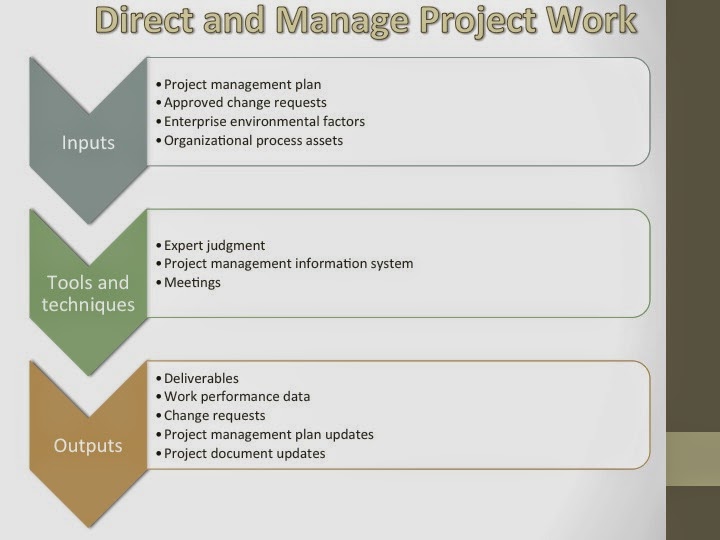
    Project Integration Management - Direct and Manage Project Work


    • This process helps you lead and perform the work defined in the project management plan as well as implement the approved changes to achieve the project's objectives. 
    Let's look at the input, tools and techniques and outputs of this process. 


    1) Project management plan

    • The plans related to directing and managing the project work from the project management plan are:
      • Scope management plan 
      • Requirements management plan
      • Schedule management plan
      • Cost management plan
      • Stakeholder management plan
    2) Approved change requests
    • Any change requested to the project plan are processed through the Perform Integrated Change Control process and approved by the change control board (CCB) first. 
    • Changes can be a corrective action, preventative action, or a defect repair. 
    • They can affect policies, project management plan, procedures, costs or schedule and all documentation should be updated with the new changes to keep documentation up to date. 
    3) Enterprise environmental factors
    • The factors outside of anyone's control that would affect the way you direct and manage the project work would be:
      • Culture and structure of organization
      • Infrastructure - existing facilities
      • Personnel administration
      • Stakeholder risk tolerances - will they allow you to be late on a deliverable? go over budget?  
      • Project management information systems
        • scheduling software tools
        • information collection and distribution system
        • online automated systems
      • Organizational structure, culture and management practices
      • Existing facilities
      • Personnel administration such as hiring guidelines or employee performance reviews
    4) Organizational process assets
    • The business organization will have many assets that will influence how you direct and manage project work that may include the following:
      • Standardized guidelines
      • Communication requirements
      • Issues and defect management procedures and databases
      • Process measurement database 
      • Project files from previous projects
    5) Expert judgement
    • The experts you consult with will help you assess the inputs needed to direct and manage the project work.
    6) Project management information system (part of the enterprise environmental factors)
    • scheduling software tools
    • information collection and distribution system
    • online automated systems
    • automated gathering of key performance indicators (KPI) 
    7) Meetings
    • There are three types of meetings:
      • Information exchange
      • Brainstorming
      • Decision making
    • You should conduct many meetings to keep everyone informed on what is going on with the project. Documentation of these meetings with meeting minutes will help track discussions and decisions that were made. 
    8) Deliverables
    • This is the product or service that is produced to complete the process. It can be a software product, training program or anything else the project plan required.
    9) Work performance data
    • The observations and data tracked during the process of the work being completed. Examples can include the following:
      • Key performing indicators (KPI)
      • Technical performance measures
      • Start and finish dates of schedule activities
      • Number of change requests
      • Number of defects
      • Actual costs
      • Actual durations
    10) Change requests
    • If any changes are determined to be made while doing this process you would submit a formal change request proposal. The changes could be requested due to the need for the following:
      • Corrective action - realign an activity tot he project management plan
      • Preventive action - make sure that future performance is aligned
      • Defect repair - modify a nonconforming product
      • Updates - changes to project documents, plans etc.
    11) Project management plan updates
    • After you direct and manage the project work there could be changes need to certain management plans that include:
      • Scope management plan
      • Requirements management plan
      • Schedule management plan
      • Cost management plan
      • Quality management plan
      • Process improvement plan
      • Human resource management plan
      • Communications management plan
      • Risk management plan
      • Procurement management plan
      • Stakeholder management plan
      • Project baselines
    12) Project document updates
    • Other documents may need updating as well that would include:
      • Requirements documentation
      • Project logs
      • Risk register
      • Stakeholder register
    Source: PMBOK 5th ed.

    Tuesday, May 13, 2014

    Project Management plans vs. Project documentation

    What is the difference between the two?

    • You will notice from the chart below that all the Project Management plans have "Management plan" after them which is easy to remember. The rest are the baselines for scope, cost and schedule. 
    • Project documents are any other documents we use during the project to track things. 


    source: PMBOK 5th ed. 

    Project Integration Management - Develop Project Management Plan

    Develop project management plan process

    • Is the process of defining, preparing, and coordinating all the plans of the project into one Project Management Plan that defines the bases of all project work. 

    Inputs, Tools and Techniques and Outputs of this process defined below:


    1) Project charter
    • The project charter contains the high-level information about the project description, budget, requirements etc. 
    • It is used as a starting point in the initial planning 
    2) Outputs from other processes
    • Many of the other processes are integrated with the development of the project management plan. If a baseline of another process becomes an output of that process then it is used as an input to the project management plan. When things change to those baselines the updates are made to the project management plan too. 
    3) Enterprise environmental factors
    • The factors outside of anyone's control that would affect the development of the project management plan would be the following:
      • Government or industry standards
      • The PM body of knowledge for a vertical market like construction or a specific market area like risk, agile development, or environmental. 
      • Project management information systems
        • scheduling software tools
        • information collection and distribution system
        • online automated systems
      • Organizational structure, culture and management practices
      • Existing facilities
      • Personnel administration such as hiring guidelines or employee performance reviews
    4) Organizational process assets
    • The business organization will have many assets that will influence how you put together the project management plan that may include the following:
      • Standardized guidelines
      • Project management plan template
      • Change control procedures
      • Previous project files
      • Historical information as well as lessons learned
      • Configuration management - baselines of standards, policies, procedures and documents
    5) Expert judgement
    • The experts you consult with will help you with many items for developing the project management plan that may include the following:
      • Determine what resources with which skill level to do the work
      • Prioritize the work on the project
      • Define the level of configuration management that needs to be applied
      • Tailor the process to meet the project needs
      • Develop the technical and management details to be included
    6) Facilitation techniques
    • To help sort through all the information you have gathered from your experts you will need to use this technique to get agreement on what to do.
    • Brainstorming, conflict resolution, and problem solving to name a few.
    7) Project Management Plan
    • Baselines used to create the project management plan:
      • Scope baseline
      • Schedule baseline
      • Cost baseline
    • Plans used to create the project management plan:
      • Scope management plan
      • Requirements management plan
      • Schedule management plan
      • Cost management plan
      • Quality management plan
      • Process improvement plan
      • Human resource management plan
      • Communications management plan
      • Risk management plan
      • Procurement management plan
      • Stakeholder management plan
    • Other items that make up the project management plan:
      • Change control systems - system that standardizes forms
      • Configuration management systems - standard tools to track and control project documentation
      • Description of how the baselines integrity will be maintained
    source: PMBOK 5th ed. 

    Project Integration Management - Develop a Project Charter

    How do we get a project started in our company?

    A project starts with an idea, business opportunity or a vision for the future. They are initiated by a sponsor who is at the level to provide funding and commit resources to the project. They will be the one to formally sign off on the Project Charter to approve the work to begin. We create a Project Charter to formally authorize the existence of a project and give the assigned project manager authority to apply organizational resources to project activities. Once created, the document is rarely changed.

    So let's look at our inputs, tools and techniques and outputs of this process. 

    1. Project statement of work (SOW):
    • It is a formal document that defines products, services, or results to be delivered by a project. 
    • It references the business need which can be based on a market demand, legal requirement or government regulation.
    • It references a product scope description that describes what the product, service or results that the project will create.
    • It references a strategic plan that outlines the business vision, goals, and objectives.
    2. Business case: 
    • It is a document that contains the necessary information to identify whether or not the project is worth the required investment. 
    •  It helps with project selection.
    3. Agreements
    • They are contracts, letters of intent, letters of agreement, email or other written agreements that define the intentions for a project.
    4. Enterprise Environmental Factors
    • They are factors that are outside of anyone's control that affect the project. The factors could be cultural, economic, logistical, or regulatory in nature. 
    • Government standards or regulations can affect the development of a project charter
    • Organizational culture and structure
    • Marketplace conditions
    5. Organizational Process Assets
    • They are the plans, processes, policies, procedures that are specifically used by the organization
    • Templates for developing a project charter that an organization uses
    • Historical information and lessons learned knowledge base that an organization has
    6. Expert Judgement
    • When defining the project charter you need the experts to help you (consultants, stakeholders, industry groups, subject matter experts and/or project management office (PMO). 
    7. Facilitation techniques
    • When you have all those people giving you their expert judgement you need to make sure you sort through the information correctly so we use facilitation techniques.
    • Brainstorming, conflict resolution, problem solving and meeting management. 
    8. Project charter
    • Now that you have taken the inputs and tools and techniques to sort through they information you now have a Project Charter. The contents will include the following:
      • Project purpose or justification
      • Measurable project objectives and relates success criteria
      • High-level requirements
      • Assumptions and constraints
      • High-level project description and boundaries
      • High-level risks
      • Summary milestone schedule
      • Summary budget
      • Stakeholder list
      • Project approval requirements
      • Assigned project manager, responsibility, and authority level
      • Name and authority of the sponsor or other person(s) authorizing the project charter
    Source: PMBOK 5th ed.

    Inputs, Tools and Techniques, and Outputs defined the simple way

    Each process contains Inputs, Tools and Techniques and Outputs. But what does this mean? 

    Basically you need compile all the items you need, do something with them and get a result.


    Lets look at the example of baking a cake.


    1) You have multiple ingredients (flour, water, egg, etc) (INPUTS)
    2) You need the mixer to mix them all together (TOOLS AND TECHNIQUES) 
    3) You need a oven safe dish to put the contents into (TOOLS AND TECHNIQUES) 
    4) You bake the ingredients in the oven for a certain amount of minutes (TOOLS AND TECHNIQUES)
    5) Finally!! a beautiful editable cake (OUTPUTS) 


    Project Integration Management - overview

    The knowledge area of Project Integration Management covers the following five processes. There are six processes that fall across all five process groups.
    1. Develop Project Charter (Initiating Process)
      • The process of developing a document to formally authorize the project and provides the project manager with the authority. 
    2. Develop Project Management Plan (Planning Process)
      • The process of defining, preparing and coordinating all subsidiary plans and combining them into the Project Management Plan.
    3. Direct and Manage Project Work (Executing Process) 
      • The process of leading and preforming the work defined in the Project Management Plan and implementing the approved changes for the projects objectives.
    4. Monitor and Control Project Work (Monitor and Control Process)
      • The process of tracking, reviewing, and reporting project progress against the performance objectives in the Project Management Plan.
    5. Preform Integrated Change Control (Monitor and Control Process)
      • The process of reviewing all change requests
      • Approve the changes
      • Manage changes to deliverables, organizational process assets, project documents, and project management plan
      • Communicate the disposition
    6. Close Project or Phase (Closing Process)
      • The process of finalizing all activities across all of the Process Groups to formally complete the project or phase. 
    So why do we need Project Integration Management you ask? Well lets look at the definition first. 

    Project Integration Management = includes the processes and activities to identify, define, combine, unify and coordinate the various processes and project management activities within the Project Management Process Groups. (PMBOK Guide 5th ed.)

    Imagine you have to hire someone to help program one of the software programs you are creating. You didn't originally plan for this and now you have to figure out where they fit into your project plan. Hiring someone increases your cost of the project so now you have to make sure the costs are still within reason of the original budget costs. Also you have to make sure that the work they are doing is being monitored so they need to be added into your human resource management plan. Because you have an extra pair of hands you can get the work done faster so you need to update your schedule of the project. 

    We as project managers have to make sure that all elements of the project plan are coordinated properly. Project integration management houses the processes that allows us to do so. It is a key element in balancing scope, time, cost, quality, human resources, communications, risk, procurement and managing the stakeholders.